
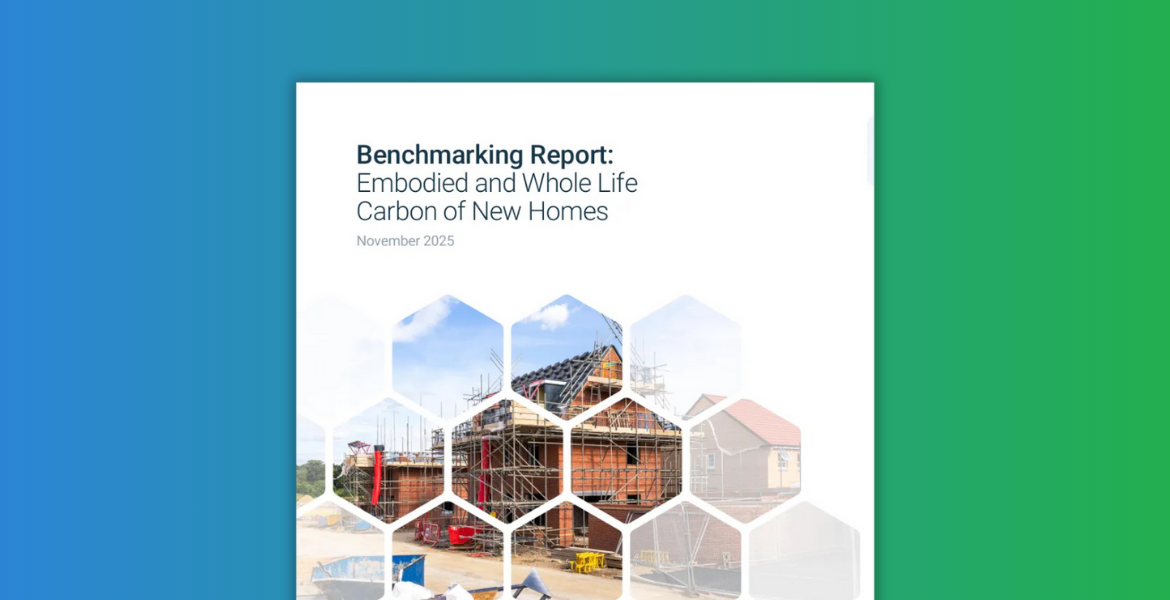
The Future Homes Hub has released its Whole Life Carbon (WLC) Benchmarking Study for 2025, a ‘landmark’ report addressing a critical knowledge gap in the UK homebuilding industry. For the first time, this study provides a vital, empirically grounded evidence base on the embodied carbon performance of new low-rise housing, guiding the sector’s collective transition to net zero.
The study’s core purpose is to create a robust snapshot of current carbon performance by analysing 48 detailed Whole Life Carbon assessments submitted by 17 industry partners. To ensure consistency, credibility, and comparability across the dataset, all assessments adhere to the rigorous standards outlined in the WLC Conventions for New Homes and RICS Professional Standard 2nd edition.
Establishing a Carbon Base Line
The top-level average (mean) carbon intensity metrics for new homes, derived from the entire dataset, are as follows:
- Upfront Carbon: 406 kgCO₂e/m²
- Whole Life Embodied Carbon: 611 kgCO₂e/m²
To ensure robust, like-for-like comparisons, the scope of these figures covers the building only, excluding development site-level impacts outside the plot boundary. It is clear that the sector needs to develop methods to capture the significant, and rarely measured, carbon impact of infrastructure and external works. However, as it stands, there is insufficient data available to provide a benchmark.
By analysing the data through different characteristics – such as dwelling type, heating fuel, and structural system – the study reveals critical trends and provides actionable insights for developers, designers, and manufacturers.
Comparing Dwelling Types and Structural Systems
Over the building’s 60-year lifespan, the whole life embodied carbon of the mechanical, electrical and plumbing systems is on average 21 kgCO2e/m2 greater for homes with a heat pump – approximately 3-4% of the whole building. This difference is likely driven by fugitive refrigerant emissions (the gradual leaking of potent greenhouse gases from the heat pump system during its operational life).
However, this is sharply contrasted and dwarfed by the operational carbon impact. The study’s most significant finding in this area is that electric-heated homes with heat pumps have on average 440 kgCO2e/m2 lower operational carbon impact over 60 years compared to homes with gas boilers. This stark contrast – cutting the operational carbon by more than half – is the report’s clearest illustration of why a whole-life carbon perspective is non-negotiable for achieving genuine decarbonisation; focusing on upfront carbon alone can lead to strategically flawed, long-term decisions.
Counter-intuitively, the empirical data suggests that detached homes have a slightly lower embodied carbon intensity than terraced homes. This finding runs contrary to some previous modelling, and the report notes that a larger dataset will be required to investigate further.
The data supports conclusions from recent studies when comparing masonry and timber frame structural systems for low-rise housing – with the data showing a lower average upfront and whole life embodied carbon for timber frame examples compared with masonry.
The Path Forward: Next Steps for the Sector
The Future Homes Hub views this report as a critical foundation for future. It will continue to gather data to refine these benchmarks and has identified several key opportunities for the sector to pursue collectively.
The organisation outlines what it believes are key priorities for the industry:
- Expand scope: develop robust methods to capture the significant carbon impacts of site preparation and infrastructure, which were excluded from this initial analysis.
- Improve data accuracy: enhance the Hub’s component benchmarks, particularly for Mechanical, Electrical, and Plumbing (MEP) systems and renewables, and champion the widespread adoption of product-specific EPDs.
- Integrate uncertainty factors: improve understanding of WLC uncertainty factors and support integration of these into assessments (up to 15% at early stages) to ensure benchmarks reflect realistic, rather than purely theoretical scenarios.
- Catalyse the supply chain: support manufacturers in developing EPDs and help homebuilders benefit from specifying verified low-carbon materials already on the market.
To spearhead this agenda, the forthcoming Embodied Carbon Implementation Board will convene stakeholders from across industry and government, providing the leadership needed to dismantle strategic barriers and capitalize on these opportunities.
Download and read the full report.
To submit your data for the second benchmarking round or join the Community of Practice group, please contact Adam Graveley at adam@futurehomes.org.uk. For more information, visit: www.futurehomes.org.uk