

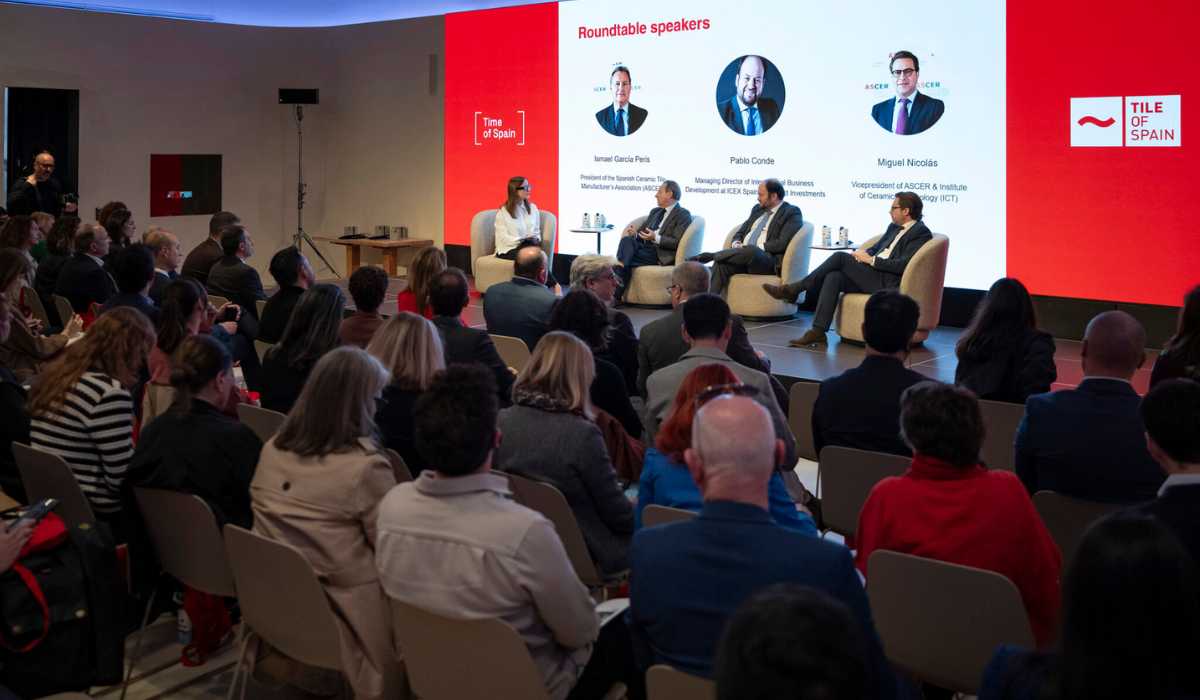
At a roundtable debate held as part of the ‘Time of Spain’ initiative, provisional data for the year ending 2025 was presented, together with future promotional and decarbonisation strategies. Taking part in the debate were Chairman of ASCER Ismael García Peris, ICEX’s Director General for International Trade Pablo Conde, and the Vice-Chairman of ASCER and the ITC Miguel Nicolás. At the event, the prize-giving ceremony of the 24th Tile of Spain Awards was also held, organised yearly by ASCER.
The sector’s economic reports suggest stabilisation in 2025, with positive indicators all round. According to the provisional end-of-year statistics for 2025, based on estimated data, it had a turnover of 4,834 million euros (+1%), with exports worth 3,484 million euros (+0.2%) and domestic sales totalling 1,350 million euros (+3.1%). Production rose by 2.7% to a figure of 427 million sqm according to data by the Institute for Industrial Productivity, and employment also rose by 1.4% with an estimated 15,939 direct jobs.
The ‘Time of Spain’ initiative, promoted during the months of February and March, aims to get across what it is that sets Spanish tiles apart, drawing attention not just to the Spanish tile sector’s products but also to its origins, industrial legacies, and the people and places around which it revolves. The participants coincided in highlighting internationalisation as one of the sector’s main cornerstones, since exports account for 72% of its total turnover.
As for sustainability, Vice-Chairman Miguel Nicolás emphasised the sector’s genuine bid to work toward decarbonisation and the energy transition through heavy investment into electrification and renewable energies. However, he warned that the road to full decarbonisation is currently conditioned by two structural constraints: shortcomings in the technological maturity of some industrial solutions and an insufficient network capacity, particularly in the province of Castellón. For this reason, he insisted on the need to align the European regulatory framework with the real availability of technology and infrastructures so as to guarantee a sustainable, competitive transition.